Wearables for Strength Athletes: How to Judge the Evidence
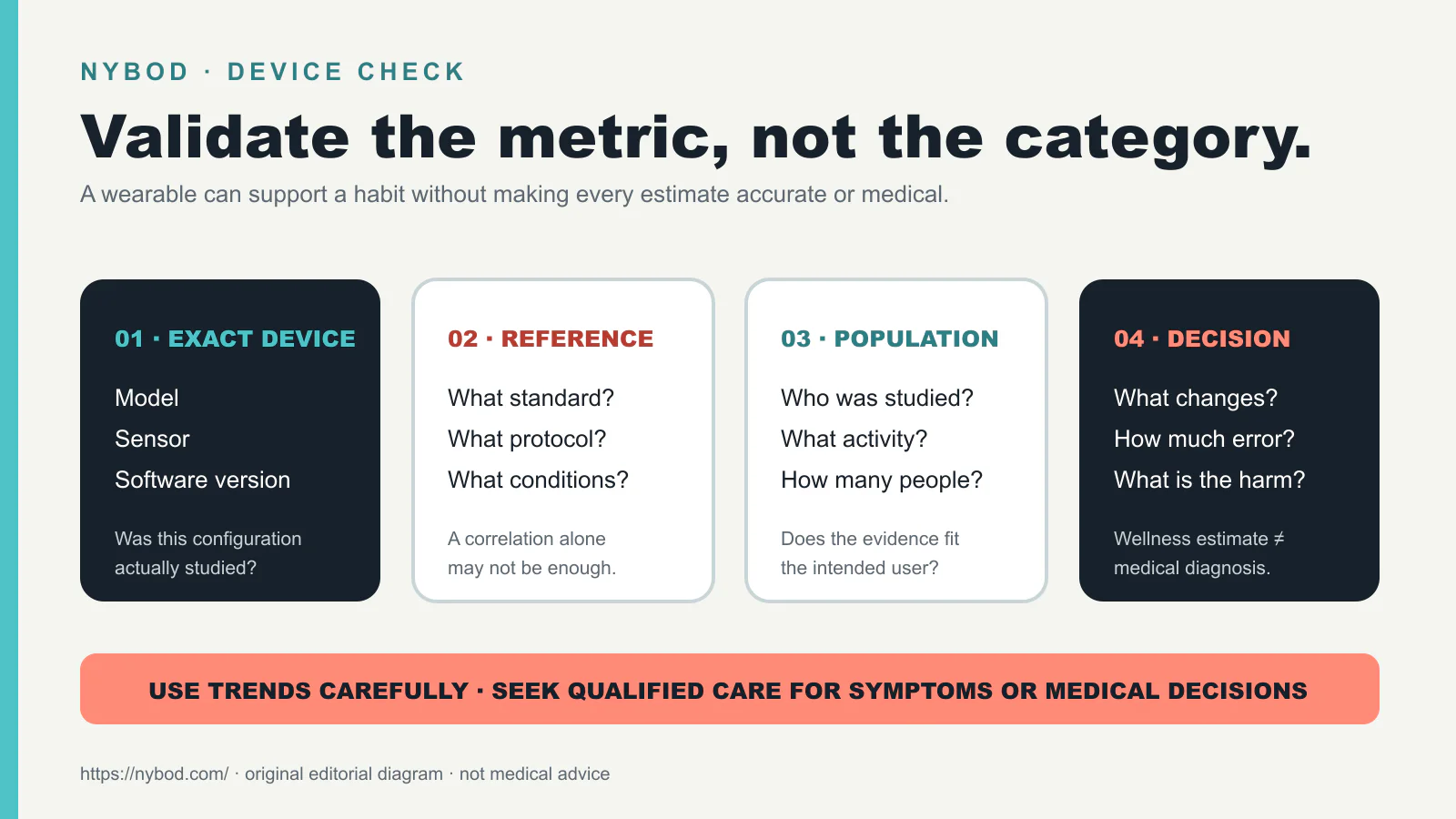
Image: NYBod
Evidence check: 27 July 2026. Wearable hardware, algorithms, and software can change after a validation study.
A wearable may help someone record consistent trends or habits. It does not automatically measure readiness, recovery, calories, sleep stages, or lifting repetitions accurately enough for a particular decision.
The FDA’s general-wellness guidance distinguishes low-risk wellness functions from functions intended to diagnose or treat disease. A consumer wellness score should not be treated as a medical diagnosis unless the specific function has the relevant authorization and is used as directed.
Validate the exact claim
Ask four questions:
- Was this exact device and software version studied?
- Was the metric compared with an appropriate reference method?
- Did the study population resemble the intended user?
- Is the error small enough for the decision being made?
A validation result for one ring does not validate all rings. A heart-rate result does not validate calorie expenditure or sleep staging on the same device.
What primary studies show
Recent device-specific research illustrates the limits:
- A 2025 study compared several consumer sleep trackers with polysomnography. Performance differed by device and sleep measure.
- A study of an Oura device evaluated energy expenditure and steps, showing why each output needs separate validation.
- A validation study compared consumer heart-rate devices under its stated protocol.
These studies do not create permanent brand rankings. Firmware, algorithms, fit, activity type, skin contact, and population can affect results.
Metrics that may support a habit
A wearable can be useful when it prompts an observable action, such as:
- keeping a more consistent sleep schedule;
- recording resting heart rate under similar conditions;
- noticing a large deviation and checking other signs;
- tracking general activity;
- logging workouts consistently.
Use trends collected under similar conditions. Do not let one proprietary score automatically cancel or intensify a workout.
Metrics to treat cautiously
- Recovery/readiness scores: combinations of proprietary inputs, not a diagnosis.
- Sleep stages: estimates that may differ from laboratory measures.
- Calorie expenditure: model-derived estimates, not direct measurements of individual energy balance.
- Rep counting: exercise- and motion-dependent.
- HRV: sensitive to measurement conditions and not a stand-alone illness or overtraining test.
A purchase worksheet
| Question | Evidence to seek |
|---|---|
| Which decision will this metric change? | A specific training or habit decision |
| Is the exact function validated? | Primary study and reference method |
| Is a subscription required? | Current written total cost |
| Can data be exported or deleted? | Current privacy and account terms |
| Will it be worn consistently? | Comfort, charging, and fit |
| What happens when the score conflicts with symptoms? | A human decision rule |
The best device cannot be chosen from “ring versus watch” alone.
Medical boundary
Seek appropriate medical care for chest pain, fainting, severe breathlessness, sustained palpitations, concerning sleep symptoms, or other health concerns. A normal consumer-device score should not delay care, and an abnormal score is not by itself a diagnosis.
Key takeaway
Buy a wearable only when a sufficiently validated metric supports a defined behavior or decision. Treat device estimates as context, not gospel.
General fitness-technology education only, not medical advice, diagnosis, or a product endorsement.
wearablesfitness gearrecoverystrength trainingtechnology