The 150-Minute Health Guideline Is Not a Bodybuilding Program

Image: NYBod
Adults are commonly told to get 150 minutes of activity per week. Lifters sometimes dismiss the number as cardio bureaucracy; beginners sometimes assume reaching it is a complete muscle-building program. Both miss what the guideline is for.
The U.S. Physical Activity Guidelines recommend 150–300 minutes of moderate-intensity aerobic activity weekly for the most health benefits, plus muscle-strengthening activity on at least two days. They also emphasize moving more and sitting less.
That is a population health framework, not a customized physique plan.
A floor is useful
The guidelines make room for many forms of movement and acknowledge that inactive people can begin with small amounts and build. That matters because a perfect training plan is irrelevant to someone who cannot yet sustain it.
For general health, the combination of aerobic and strengthening activity addresses more than appearance or one-repetition maximum. Walking does not cancel lifting, and lifting does not make all cardiovascular work redundant.
Goal-specific work comes next
If the goal is maximal strength, programming needs specific practice with heavier loads, enough sets, technique, and recovery. If the goal is hypertrophy, multiple resistance-training prescriptions can work, with weekly volume and progressive overload becoming important. If the goal is sport, conditioning must match sport demands.
A network meta-analysis of resistance-training prescriptions found that all examined resistance-training approaches beat no exercise for strength and hypertrophy, while higher loads ranked best for strength and multiset programs ranked strongly for hypertrophy.
The takeaway is not one winning routine. It is that the health floor and the performance ceiling are different layers.
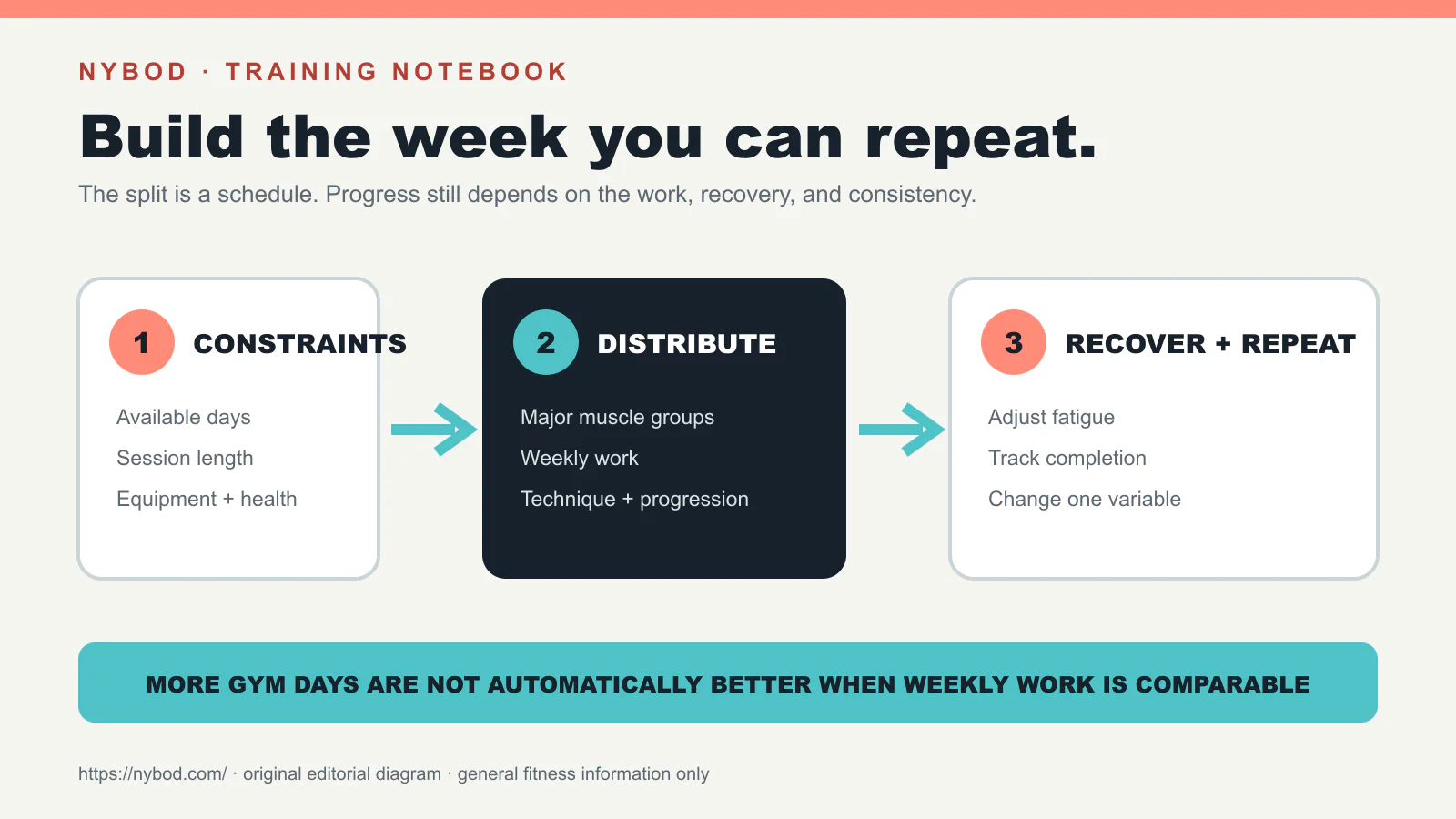
Build the week in order
- Put two realistic strengthening days on the calendar.
- Accumulate aerobic minutes through sessions and daily movement.
- Add goal-specific volume only when recovery and attendance remain stable.
- Progress one variable at a time.
- Reduce or modify work when pain, illness, or medical advice requires it.
Sources and limits
- U.S. Physical Activity Guidelines: key recommendations
- PubMed: resistance-training prescription network meta-analysis
Guidelines do not replace individual medical screening or rehabilitation. Start appropriately and seek qualified help when needed.
Key takeaway
The public-health guideline tells adults how to avoid doing too little. A bodybuilding, strength, or sport program must then specify what to practice, how much, how hard, and how to progress.
physical activity guidelinesstrength trainingcardiohealth