Training Splits for Busy Professionals: An Evidence-Aware Guide
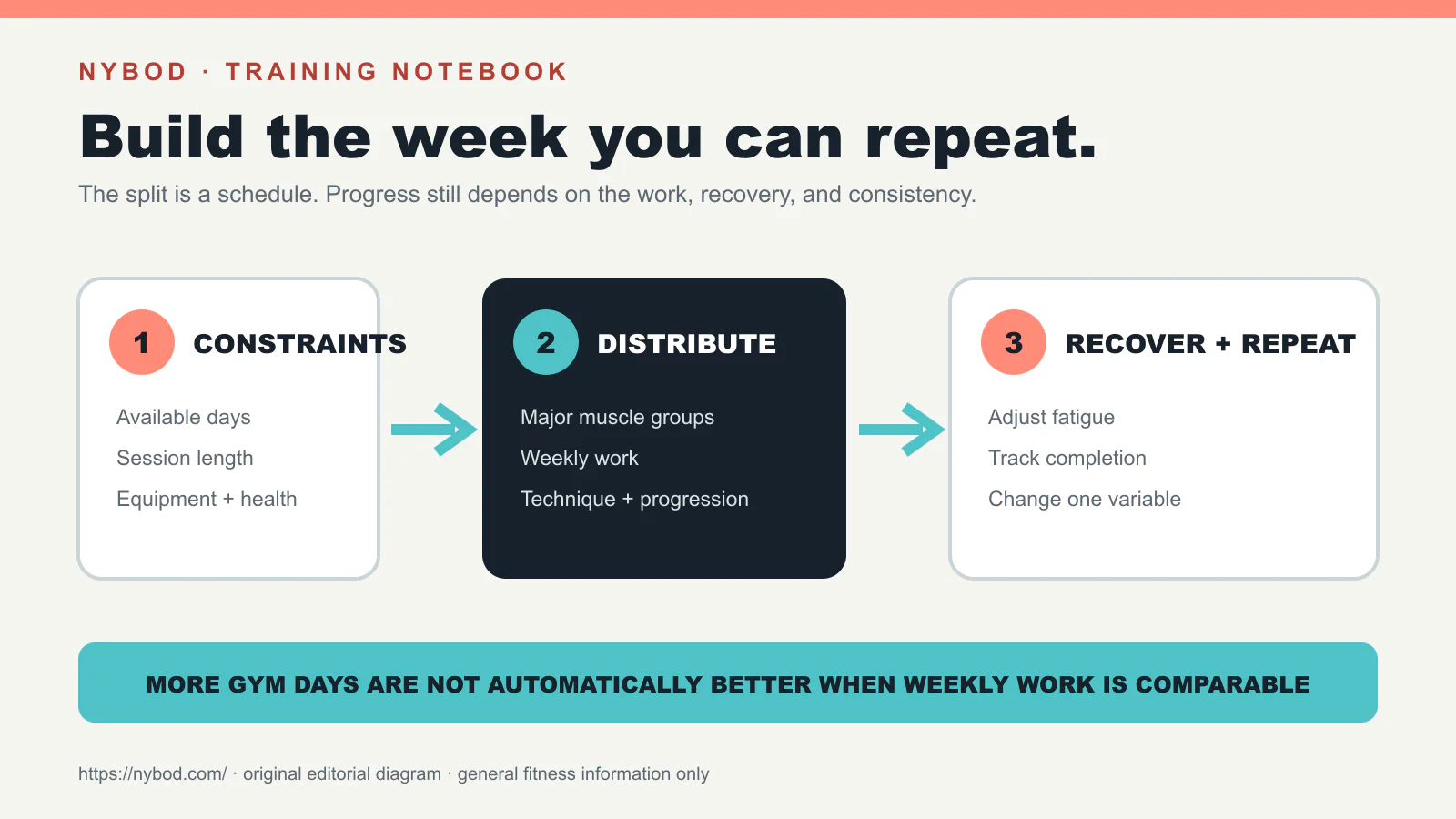
Image: NYBod
Evidence check: 27 July 2026. Exercise needs vary with health, experience, goals, recovery, and available equipment.
A training split is simply the way exercise is distributed across the week. It does not determine results by itself. Exercise selection, total work, effort, progression, recovery, technique, and consistency also matter.
The U.S. government’s Physical Activity Guidelines recommend muscle-strengthening activity involving all major muscle groups on two or more days each week for adults. The interactive Move Your Way planner translates that public-health baseline into a weekly plan.
What the evidence says about frequency
Two primary training studies are useful for schedule design:
- A randomized trial comparing two versus four weekly resistance-training days reported similar adaptations when weekly volume was equated in the studied participants.
- Another trial comparing a twice-weekly full-body routine with a four-day split routine also found similar outcomes under the study conditions.
These studies do not prove that schedule never matters. They support a narrower conclusion: more gym days are not automatically better when the important training work is otherwise comparable.
ACSM’s 2026 resistance-training update likewise emphasizes consistent, individualized training rather than unnecessary complexity.
Illustrative schedule options
These are examples, not prescriptions.
Two days: full body
- Day 1: lower-body pattern, push, pull, trunk
- Day 2: different lower-body pattern, push, pull, trunk
This format places more work in each session and leaves more nonlifting days.
Three days: full body or rotating emphasis
- Day 1: full body, emphasis A
- Day 2: full body, emphasis B
- Day 3: full body, emphasis C
The emphasis can change without excluding the other major muscle groups.
Four days: upper/lower
- Day 1: upper body
- Day 2: lower body
- Day 3: upper body
- Day 4: lower body
This distributes work across shorter sessions but requires more weekly visits.
Choose by constraints
Ask:
- How many sessions can be completed most weeks?
- Which major muscle groups and movement patterns need coverage?
- How much work can be performed with sound technique in one session?
- Does soreness or fatigue interfere with work, sleep, or the next session?
- Is performance stable or improving over several weeks?
There is no evidence-based universal 45- or 60-minute cap. Session length is a planning variable, not a quality score.
Make the plan measurable
Track a small set of variables:
- exercise and load;
- repetitions and sets;
- perceived effort or repetitions in reserve;
- pain or unusual symptoms;
- whether the planned session was completed;
- performance across comparable sessions.
Change one variable at a time. If attendance is the problem, reduce complexity or session length before adding more days.
Cardio and recovery
The national guidelines also recommend aerobic activity. Where cardio fits depends on goals, intensity, schedule, and individual response. There is no universal rule that it must follow lifting or occur on a separate day.
Rest days do not need to be labeled “active recovery.” Normal daily movement can continue unless a clinician or rehabilitation plan says otherwise.
Safety
People who are new to resistance training, pregnant, recovering from injury, living with a medical condition, or experiencing chest pain, fainting, severe breathlessness, or unusual pain should obtain appropriate professional guidance.
Key takeaway
Use the simplest split that covers the major muscle groups, supports progressive training, and survives real scheduling constraints. Frequency is one variable, not the program.
General fitness education only, not medical diagnosis, treatment, or individualized exercise programming.
training splitsworkout routinestrength trainingtime managementfull body